




A loading dock is often the hardest-working opening in a facility. Forklifts, pallet jacks, delivery vehicles and staff can pass through it hundreds of times a day, while the opening must still protect stock, manage temperature, control access and withstand weather exposure. Dock doors are therefore operational infrastructure, not a standard building item selected late in a project.
The right door depends on how the dock operates when vehicles are arriving, loading and departing. Door size, cycle frequency, environmental separation, security requirements and the type of dock equipment all affect the specification. A door that suits a low-volume warehouse may quickly become a source of delays, damage and energy loss in a distribution centre, food facility or manufacturing plant.
What dock doors need to manage
A dock opening sits between two different environments: the external loading area and the controlled conditions inside the building. This creates competing requirements. The door needs to open quickly enough to keep goods moving, yet close reliably to limit unauthorised access, dust, rain, pests and temperature transfer.
For ambient warehouses, durability and security may be the primary concerns. In chilled or frozen operations, even short periods with the opening exposed can add to refrigeration load and make it harder to hold stable temperatures. In food processing, pharmaceutical and healthcare supply environments, the doorway also has a role in hygiene control and cleanable separation.
Traffic is equally important. A dock used by a small number of scheduled trucks has a different duty cycle from one serving continuous despatch activity. Repeated impacts from handling equipment, rushed operators and poor alignment between the truck, dock platform and opening can all shorten door life. The specification should account for these predictable conditions rather than assume careful, occasional use.
Choosing dock doors for the application
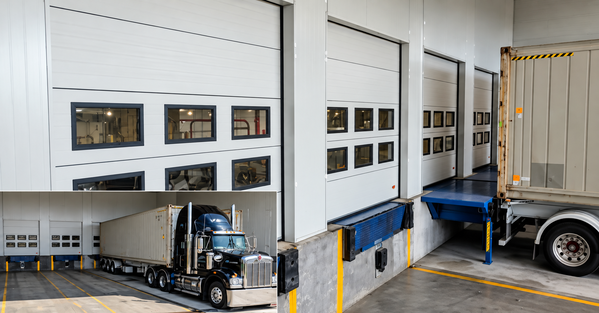
Sectional overhead doors are a common choice for loading docks because they provide a secure, durable closure while keeping the area above the opening clear when open. They suit warehouses, industrial sites and commercial loading areas where the door must tolerate regular operation and provide dependable perimeter security after hours.
The panel construction, track arrangement, insulation level and operating system should be selected for the building and its duty cycle. Insulated sectional doors can assist with thermal performance where the dock adjoins a temperature-controlled space. Window options may improve visibility, although glazing should be considered against security, impact exposure and the operating environment.
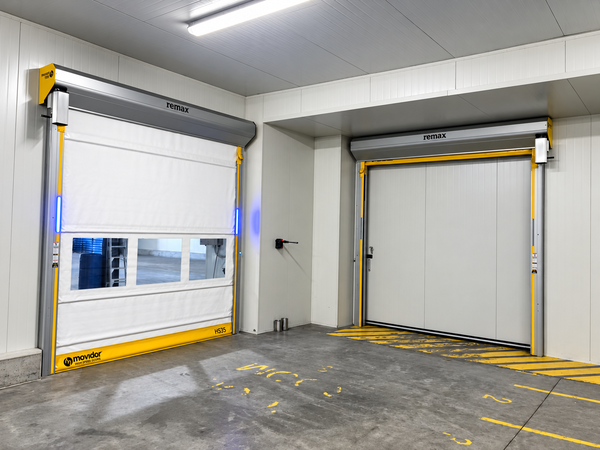
Where traffic speed is the overriding concern, rapid roller doors may be more suitable. Their fast opening and closing cycles reduce the time an opening is exposed, helping maintain internal conditions and improving traffic flow. They are particularly useful at internal transfer points, high-throughput despatch areas and temperature-sensitive facilities. At an external dock, a rapid door may work alongside a more secure outer closure, depending on the level of security and weather protection required.
For smaller service openings or pedestrian-access locations within a loading area, industrial swing doors can provide a practical separation between work zones. Impact-resistant panels, vision panels and corrosion-resistant materials may be appropriate where trolleys, washdown activity or frequent personnel movement are expected.
The correct choice is not always one door type across every opening. A facility may need sectional doors on its external vehicle docks, rapid doors between staging and production, and specialised swing doors at staff or hygiene transition points. Matching each opening to its actual use generally produces better lifecycle value than applying a single product by default.
Size, clearance and dock geometry
Door width and height must accommodate the largest vehicle interface and the equipment moving through the opening, with practical allowance for load variation and operator visibility. A door that is technically large enough can still be inefficient if drivers or forklift operators must manoeuvre tightly at every movement.
Headroom, side room and internal ceiling services also influence what can be installed. Tracks, motors, sprinklers, lights, ductwork and racking can compete for the same space. Early coordination between the door supplier, builder, architect and services trades avoids site changes that can delay installation or compromise the intended operation.
Dock geometry matters outside the building as well. Vehicle approach angles, dock height, bumpers, shelters, levellers and wheel restraints all influence how consistently trucks align with the opening. Poor alignment increases the likelihood of door impact and leaves larger gaps that compromise weather and temperature control.
Safety systems are part of the door system
A powered dock door should be specified as part of a controlled loading process, not as an isolated piece of equipment. Safety devices can include photoelectric sensors, light curtains, safety edges, warning lights, audible alerts and interlocks with dock levellers or vehicle restraint equipment.
The appropriate level of control depends on site risk. On a busy dock, an interlock may prevent the door from opening until the vehicle is correctly positioned, or prevent a leveller from operating until the door is raised. These arrangements can reduce exposure to unsafe loading sequences, but they must be designed around real workflows. If controls are overly complicated or create unnecessary delays, operators may work around them.
Visibility also deserves attention. Vision panels, appropriate lighting and clearly marked travel paths help people understand what is occurring on the other side of the opening. However, no sensor or window replaces disciplined traffic management. Separate pedestrian routes, exclusion zones and operator training remain essential where forklifts and trucks share the dock area.
Temperature, hygiene and weather control
An open dock doorway can be one of the largest sources of uncontrolled air movement in a facility. This has direct implications for refrigeration costs, condensation, dust ingress and staff comfort. The solution is usually a combination of equipment rather than a door alone.
Dock shelters and seals reduce gaps around a backed-in vehicle. Insulated doors limit heat transfer when closed. Rapid doors reduce exposure time during active movements. PVC strip curtains can provide a flexible secondary barrier where frequent forklift travel makes a fully closed door impractical. Each measure has a different role, and their effectiveness depends on correct sizing and installation.
In washdown, food and corrosive environments, material selection becomes critical. Stainless steel components and hygienic door designs can be preferable where moisture, cleaning chemicals or strict sanitation routines would degrade conventional hardware. Smooth, cleanable surfaces and fewer dirt-trapping details support easier maintenance, but the door must still be built for the traffic and impacts it will face.
Specify for serviceability, not just installation
The cost of a dock door is not limited to its purchase price. A failed spring, damaged panel, misaligned track or faulty sensor can stop a loading lane and disrupt production or despatch. For a high-use facility, downtime can cost more than the original equipment saving achieved through a lower-grade specification.
Service access, availability of replacement parts and preventative maintenance should be considered before the door is installed. High-cycle components require inspection and adjustment over time. Tracks need to remain aligned, moving parts need checking, safety devices need functional testing, and damaged seals or panels should be addressed before they create larger issues.
A planned maintenance programme allows wear to be identified during scheduled visits rather than during a truck arrival or peak dispatch period. It also provides a useful record of recurring impacts, component failures and usage patterns. That information can guide upgrades, changes to traffic management or a different door configuration at future openings.
Remax Doors approaches dock access as a full-lifecycle requirement, combining locally engineered door systems with installation, inspections, repairs and ongoing servicing for demanding Australian facilities.
A practical approach to dock door specification
Start with the operating sequence. Consider what arrives at the dock, how often it arrives, who uses the opening, what conditions must be protected and what happens if that loading lane is unavailable. This is more useful than beginning with a preferred door style.
Then assess the physical opening, available clearances, vehicle types, dock equipment and building services. Confirm the required security level after hours and identify whether the opening separates ambient, chilled, clean or washdown spaces. Finally, establish the maintenance expectations and response requirements before selecting the system.
A well-specified dock door should make loading activity safer and more predictable without becoming a bottleneck. When the opening is engineered around traffic, environment and service requirements, it supports the work that keeps the facility moving.