




If you manage a busy warehouse, distribution centre or industrial facility, you’ve probably seen it and didn't think too much about it - a forklift waiting at the doorway.
It might only be a few seconds each time. But when the same doorway is being used hundreds of times throughout the day, those seconds can quickly add up.
The question isn’t simply how fast your door opens.
It’s how often your operation is waiting for it.
How long does an industrial door take to open?
There isn’t one standard speed for an industrial roller shutter. Door size, weight, motor, controls and specification all affect how quickly it operates.
For a realistic example, consider a 3-metre-high industrial doorway.
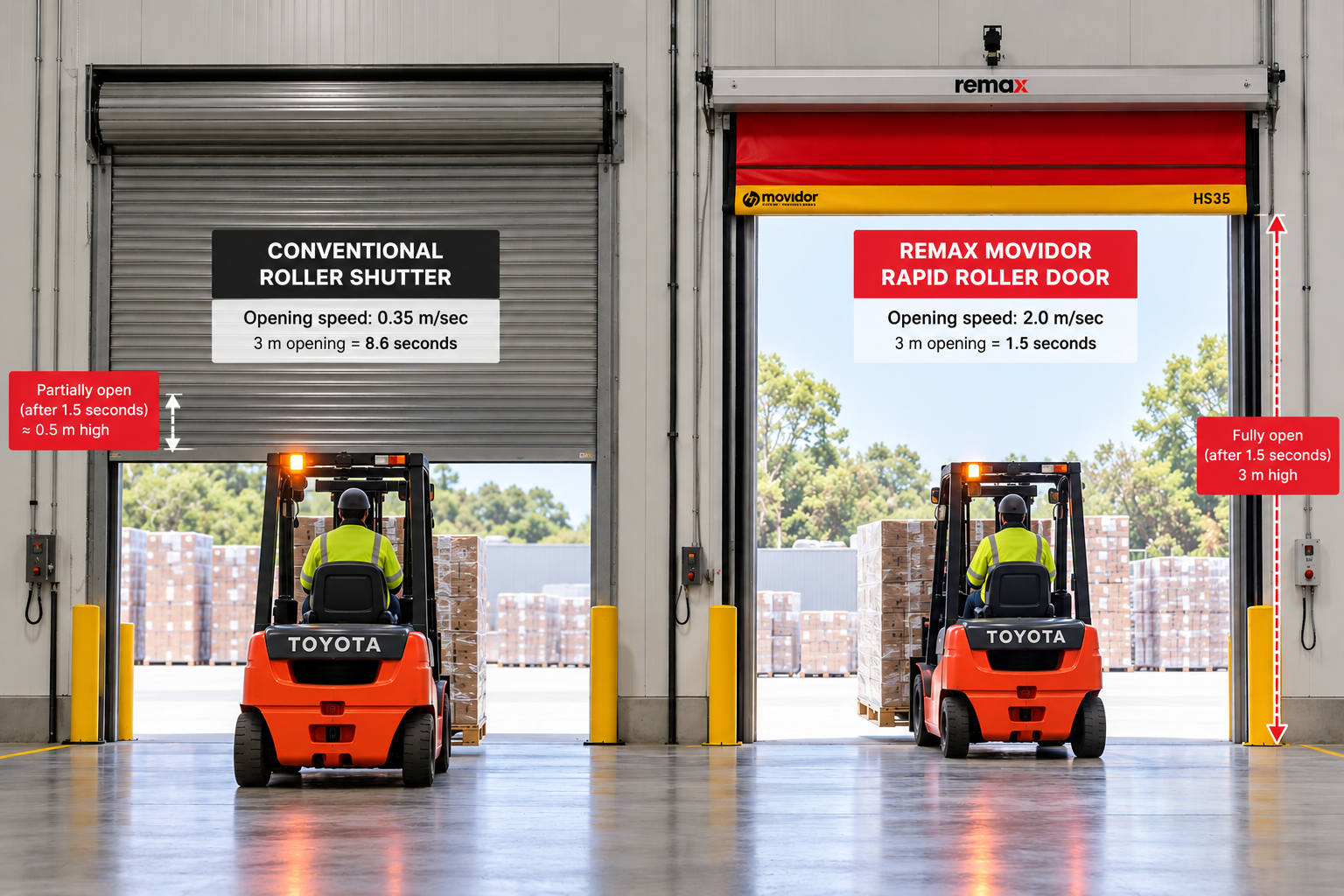
Some industrial roller shutter systems have published opening speeds of up to 0.35 metres per second. At that speed, a 3-metre-high door would take approximately:
8.6 seconds to fully open
A high-speed door operating at 2 metres per second would cover the same distance in approximately: 1.5 seconds to fully open
That’s a difference of approximately 7 seconds on a single opening.
Seven seconds doesn’t sound like much. But how many times does that door open every day?
This is an illustrative comparison based on a 3m-high opening and door speeds of 0.35m/sec and 2.0m/sec. Actual operating speeds and cycle times vary by door model, dimensions, controls and application.
What happens when you multiply that across the day?
A doorway that operates occasionally is very different from one sitting in the middle of a busy warehouse workflow.
Consider two examples. Forklift on the left waiting for the door to fully open vs the forklift on the right which is already through the doorway.
1. Lower-traffic warehouse: 40 openings per day
A smaller warehouse may use a particular access point around five times per hour across an eight-hour shift.
At 40 openings per day:
Door operating at 0.35m/sec
40 × 8.6 seconds
= approximately 5 minutes 43 seconds of opening travel
High-speed door operating at 2.0m/sec
40 × 1.5 seconds
= 1 minute of opening travel
That's a difference of less than five minutes across the day. For a relatively low-use doorway, opening speed alone may not be a major operational concern. But increase the traffic and the calculation starts to look very different.
2. Busy warehouse: 300 openings per day
Now consider a doorway servicing a busy warehouse, manufacturing facility or distribution centre.
Deliveries arrive. Forklifts move pallets between areas. Finished product leaves the facility. Employees and equipment repeatedly travel through the same access point.
If the door opens 300 times during the day:
Door operating at 0.35m/sec
300 × 8.6 seconds
= approximately 43 minutes of opening travel
High-speed door operating at 2.0m/sec
300 × 1.5 seconds
= 7 minutes 30 seconds of opening travel
That's approximately 35 minutes difference in accumulated opening time.
That doesn't mean installing a high-speed door automatically creates 35 minutes of additional productivity every day, thats nearly 3 hours per week, approx 151 hours per year! So for a standard Australian 38-hour working week (7.6 hours/day), 151 hours ≈ 20 working days, or almost exactly 4 working weeks. Struth.
Vehicles still need to approach and move safely through the opening. Actual cycle times are also affected by activation methods, closing speeds, hold-open periods and traffic patterns.
What the calculation does show is how small, repeated delays can accumulate at a high-traffic doorway.
Is the door actually creating a bottleneck?
You don't necessarily need to count every door cycle to identify a problem.
Spend ten minutes watching one of your busiest access points during a normal shift. Look at what happens when traffic approaches.
Does a forklift arrive and stop while the door opens? Does another vehicle begin queuing behind it? Are employees waiting to walk through? Is product sitting still while the opening clears?
Does this happen occasionally, or does the same pattern repeat throughout the day? One wait probably doesn't matter. The same wait, hundreds of times a day, might.
The right door depends on the job
This isn't about saying that every industrial facility needs a rapid door.
A conventional roller shutter can be entirely appropriate for an opening that is primarily required for security and only operates a handful of times each day.
But the requirements change when a doorway becomes part of the operational workflow.
If forklifts, people and product are moving through the opening continuously, factors such as opening speed, activation, cycle frequency, reliability and impact recovery become much more important.
The question becomes:
Is the door being used for the job it was designed to do?
A doorway that worked perfectly well when a facility was quieter may become a bottleneck as production volumes, staffing or vehicle movements increase.
Opening speed is only part of the equation
A faster door alone doesn't guarantee better traffic flow.
How the door knows when to open matters too.
Sensors, radar, induction loops and other automatic activation methods can allow a rapid door to respond as authorised traffic approaches.
Instead of a forklift arriving at a closed doorway, stopping and waiting for the entire opening cycle, the door can begin opening before the vehicle reaches it.
The aim is to create a smoother movement through the access point while maintaining safe separation between traffic and the door.
What happens after the forklift passes through?
Traffic flow isn't the only reason door speed matters.
Every second an external or temperature-controlled doorway remains open is another second that the conditions on either side of the opening can interact. Warm air can enter a temperature-controlled area. Conditioned air can escape. Dust and insects have another opportunity to enter the facility.
For food manufacturing, cold storage, logistics and temperature-sensitive operations, reducing unnecessary open time can therefore help support:
- Temperature control
- Energy efficiency
- Pest management
- Dust and hygiene control
- Separation between operational areas
The goal isn't simply to have the fastest door.
It's to have a door that opens when it's needed, allows traffic to move through efficiently and closes again when it isn't.
High traffic also means a greater chance of impact
The more frequently forklifts and equipment move through a doorway, the greater the opportunity for accidental impacts.
A forklift clips the curtain. A pallet catches the edge. A vehicle approaches from an unexpected angle.
If a minor impact takes the doorway out of operation, the disruption can be considerably greater than the seconds spent waiting for it to open.
This is why speed needs to be considered alongside reliability.
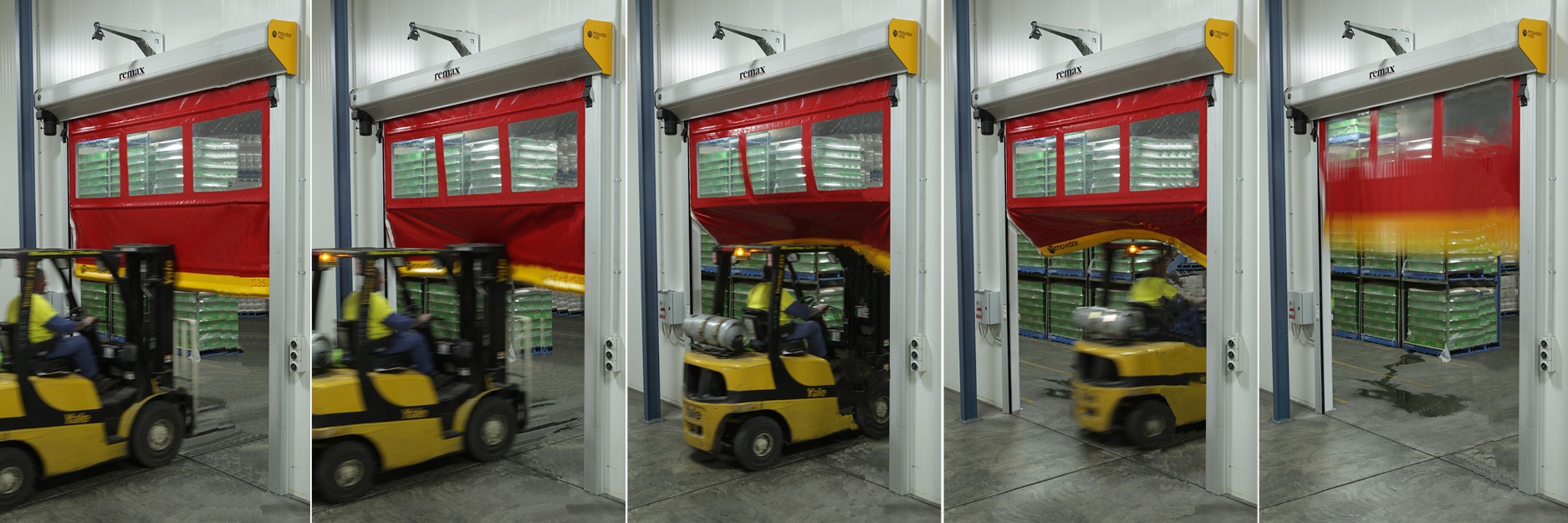
The Remax Movidor Rapid Roller Door uses a self-relocating curtain designed to reset following an accidental impact, helping reduce unnecessary disruption and service call-outs in high-traffic industrial environments.
Three questions to ask at your busiest doorway
If you're trying to identify whether a doorway is affecting traffic flow, start with three questions.
1. How often is it opening?
A door operating 20 times per day presents a very different requirement from one operating 300 times.
2. What's moving through it?
People, forklifts, pallet movers, products or a combination of traffic?
3. What's waiting?
If vehicles, people or products regularly stop at the same access point, there may be an opportunity to improve the flow.

How often are you waiting for a door to open?
Improving warehouse efficiency doesn't always mean redesigning an entire process.
Sometimes it's worth starting with one of the most frequently used pieces of equipment in the facility. The doorway.
If people, forklifts or products regularly wait at the same access point, take a closer look at how often the door operates, how quickly it responds and whether it still suits the way your facility works today.
Remax Doors manufactures Movidor Rapid Roller Doors in Australia for high-traffic industrial environments, with opening speeds of up to 2.0m/sec depending on the model.
Arrange an onsite assessment with Remax Doors to find out whether your current doorway is keeping up with your operation.