




A rapid roller door that keeps reversing, opens when nobody is approaching or fails to detect an obstruction can disrupt your entire operation. Forklifts are left waiting, conditioned air escapes and staff may be exposed to unnecessary risks.
Before changing any settings, it's important to understand what the sensor is designed to do and whether the problem is caused by calibration, damage or another door component.
How do you calibrate industrial door sensors?
Industrial door sensor calibration involves checking alignment, detection zones, controller settings and safety responses against the manufacturer's specifications. The exact process depends on the door model, sensor technology and operating environment.
Facility managers can identify visible damage, record faults and arrange servicing. However, adjustments to safety-critical sensors, electrical controls and door travel settings should be carried out by a suitably qualified technician.
This is consistent with Safe Work Australia's Model Code of Practice: Managing Risks of Plant in the Workplace, which provides guidance on managing risks associated with workplace machinery and equipment.
A door should not be returned to service until its required safety functions have been tested and verified.
What are the signs that an industrial door sensor needs attention?
Sensor problems often appear as small operational interruptions before they become a breakdown.
Common warning signs include:
- The door opens without approaching traffic. Motion sensors may be detecting passing forklifts, nearby movement or environmental interference.
- The door repeatedly stops or reverses. A safety beam or light curtain may be obstructed, misaligned, contaminated or faulty.
- The door does not respond when traffic approaches. An activation sensor may have an unsuitable detection zone, or there may be an electrical or controller fault.
- The door does not close fully. The problem may involve travel limits, seals, mechanical alignment or the control system rather than the sensor itself.
- Faults occur intermittently. Vibration, moisture, dust, condensation or damaged wiring may be affecting sensor performance.
In high-traffic facilities, these interruptions can create forklift queues, slow dispatch and increase the time a doorway remains open.
Effective traffic management is also important around busy doorways. SafeWork NSW provides practical guidance on forklift risks, safety and workplace traffic management.
What types of sensors are used on industrial doors?
Industrial doors can use several different devices to manage activation, positioning and safety.
|
Device |
Main function |
|
Photoelectric (PE) beam |
Detects an obstruction across a defined beam path |
|
Safety light curtain |
Monitors a larger protected area of the doorway |
|
Motion or radar sensor |
Detects approaching movement and initiates opening |
|
Safety edge |
Provides contact-sensitive protection on applicable door designs |
|
Induction loop |
Detects suitable vehicles within a defined area |
|
Limit switch or encoder |
Helps the controller determine door travel positions |
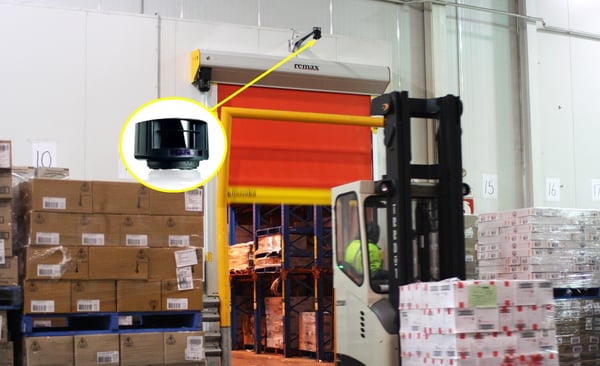
These devices do not all perform the same function. An activation sensor that triggers too frequently can increase door cycles and energy loss. A safety device that fails to detect an obstruction creates a more serious risk.
SafeWork NSW provides further information about plant, machinery and equipment safety, including workplace responsibilities for managing machinery-related risks.
Depending on the model and configuration, Remax Movidor Rapid Roller Doors incorporate integrated sensors and a soft-edge curtain design, with additional safety options available for specific applications.
What should you check before arranging sensor calibration?
There are several useful observations a facility manager can make without opening a controller or adjusting safety settings.
1. Check for visible obstructions or damage
Look for packaging, dust, dirt or other material obstructing the sensor's detection area.
Check whether sensor housings or mounting brackets appear damaged or displaced, particularly where forklifts operate close to the doorway.
Only carry out cleaning or inspection that is permitted by the manufacturer's instructions and your site's safety procedures.
2. Record when the problem occurs
Does the door reverse every time it closes, or only when a forklift passes nearby?
Does the problem occur during wash-down, in strong sunlight or when condensation develops?
Record the conditions surrounding the fault. This information can help a technician identify whether the issue involves sensor alignment, environmental interference or another component.
If the issue persists or involves a safety-critical component, contact Remax Technical Support to discuss the fault and arrange an appropriate inspection.
3. Identify which door function is affected
Determine whether the problem relates to opening, obstruction detection, closing or the door's final position.
This distinction matters because a door that opens unnecessarily may require a different investigation from one that fails to respond to its safety devices.
4. Check the maintenance history
Review previous service reports and recurring faults.
If a sensor has been adjusted repeatedly but the problem returns, further calibration may not resolve the underlying cause.
Important: Never bypass a PE beam, light curtain, safety edge or another required safety device to keep a faulty door operating.
How does a technician calibrate industrial door sensors?
The procedure varies by manufacturer and controller, but a professional inspection may involve the following checks.
Professional industrial door servicing and maintenance from Remax can help identify whether recurring sensor faults are related to alignment, electrical controls, mechanical wear or other door components.
Sensor alignment and condition
The technician checks that photoelectric beams, reflectors or light curtains are correctly positioned, securely mounted and functioning across their intended detection areas.
Damaged housings, cables or mounting components may require repair or replacement.
Activation detection zones
Where motion or radar sensors are fitted, the technician checks whether the detection area suits the doorway's traffic.
In a warehouse, the sensor needs to respond to approaching forklifts without unnecessarily activating whenever a vehicle passes along an adjacent aisle.
The objective is dependable activation without excessive door cycling.
Safety device operation
Safety beams, light curtains and applicable safety edges must respond correctly when tested using approved methods.
A normal indicator light alone does not establish that a safety device is working correctly.
Door travel and controller settings
The technician may also check the door's open and closed positions, controller fault history and operating sequence.
Incorrect travel limits can affect sealing, clearance and door operation. These settings should be assessed alongside the door's mechanical condition and safety systems.
Operational testing
After authorised adjustments or repairs, the door should be tested under representative operating conditions.
This may include normal pedestrian and forklift approaches, repeated cycles and verification of the relevant safety functions.
The findings and work completed should be documented.
Why do industrial door sensors keep losing alignment?
A recurring sensor problem is not always caused by incorrect settings.
In busy industrial environments, several factors can affect reliability.
Forklift traffic and accidental impacts: A vehicle strike may shift a bracket, damage wiring or affect the door's alignment.
Wash-down and moisture: Food processing facilities may expose equipment to water, cleaning chemicals and residue.
Cold-room condensation: Temperature differences and moisture can interfere with some sensor technologies.
Vibration and repeated cycles: Frequent door operation may contribute to loose mounting components or reveal existing mechanical problems.
Dust and airborne contamination: Warehouses and manufacturing facilities may experience sensor contamination that requires regular inspection.
If an impact has damaged the door or its components, Remax Repairs and Breakdown Call-outs can help arrange an inspection and appropriate repair.
If a problem returns shortly after adjustment, the underlying cause should be investigated rather than repeatedly increasing sensor sensitivity.
Can incorrect sensor settings affect temperature control?
Yes. Sensor settings can influence how frequently a door opens and how long it remains open.
In cold storage, food processing and temperature-controlled warehouses, unnecessary opening cycles can increase the movement of warm or cold air between spaces.
An activation zone that is too wide may cause the door to open for traffic that is not actually approaching the doorway. This can increase unnecessary door cycles and affect temperature management.
The appropriate detection area should suit the layout, traffic patterns and operating requirements of the facility.
Maintaining reliable industrial door sensor performance
Regular inspections and preventative maintenance can help identify developing faults before they cause unexpected operational interruptions.
Remax Preventative Maintenance Service Plans include scheduled six-monthly servicing to manufacturer specifications, along with service reporting and documentation.
For facilities relying on high-speed doors throughout the day, keeping sensors, safety devices and mechanical components in suitable working condition is an important part of maintaining reliable access and safe operations.
If your industrial door is reversing unexpectedly, failing to detect approaching traffic or experiencing recurring sensor faults, arrange a professional inspection before the problem affects your operation further.
Contact Remax Doors on 1800 010 221 to discuss servicing and technical support.