




Last Updated: November 10, 2026
Quick Summary
Reduce facility downtime by treating doorways as a planned part of operations, not an afterthought. Set maintenance intervals based on how often each door cycles, check tracks, seals and sensors, and keep spare parts for components that wear fastest. Logging real cycle performance helps catch problems before they stop production.
- Frequent forklift traffic wears tracks and seals faster than expected.
- Set inspection intervals based on how often each door cycles.
- Test opening and closing speed and listen for unusual noise.
- Keep spare parts on hand for components that wear fastest.
- Schedule safety checks during planned downtime to limit disruption.
Table of Contents
- Where Facility Downtime Starts at the Doorway
- Building an Industrial Door Maintenance Schedule
- Keeping Work Health and Safety Act 2011 Compliance in View While Minimising Production Bottlenecks
- Frequently Asked Questions
Where Facility Downtime Starts at the Doorway
A forklift waits at a doorway while the roller door crawls open. The line behind it slows, a pallet misses its truck, and a small delay becomes a late shipment. Facility downtime often starts with access points like this, where traffic, temperature and repairs meet.
Remax Doors manufactures industrial and commercial doorway solutions in Australia. Doors that are slow to cycle, damaged by impacts or poorly sealed can each interrupt production. The door alone does not cause downtime, but it sits at the point where daily operations pass through. Because these doorways sit at the point where operations pass through, maintaining commercial rapid roller doors helps keep wear, damage and sealing problems from becoming avoidable interruptions.
- Frequent forklift traffic wears tracks and seals faster than expected.
- Slow opening speeds hold up material movement.
- Impact damage can take a door out of service until it is repaired.
A planned maintenance schedule keeps doors working and makes repairs predictable. Unplanned repairs tend to cost more time than scheduled checks, so start with a simple routine. Our Rapid Door Preventative Maintenance service is one way to set up that routine across a site.
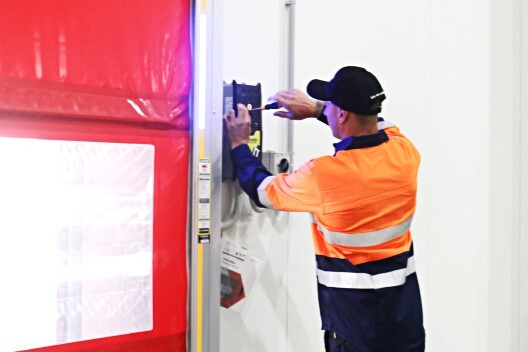
Set inspection intervals based on how often each door cycles. A door at a busy loading bay needs checks more often than a rarely used internal access point. Record what you find each time so trends show up early.
- Check tracks, seals and guides for wear or debris.
- Test opening and closing speed, and listen for unusual noise.
- Confirm safety edges and sensors respond correctly.
- Keep spare parts on hand for components that wear fastest.
Watch out: a door that works in a quick test can still fail under full daily load, so log real cycle performance, not just a single check.
Remax Doors offers Work Health and Safety resources for Remax door brochures and planned preventative maintenance service plans to help teams set up a schedule.
The table below summarises the scheduling and checks covered in this section, so you can set up a routine for each door.
| Check | What to look for | How often |
|---|---|---|
| Tracks, seals and guides | Wear or debris | Set by how often the door cycles |
| Opening and closing speed | Slow cycling or unusual noise | Set by how often the door cycles |
| Safety edges and sensors | Correct response | Set by how often the door cycles |
| Spare parts | Components that wear fastest | Keep on hand |
| Inspection records | Trends over time | Record each inspection |
Keeping Work Health and Safety Act 2011 Compliance in View While Minimising Production Bottlenecks
Doors are part of a site's safety picture, and maintenance supports it. Under the model Work Health and Safety laws, a person conducting a business must manage risks to workers, including risks from plant such as doors. Check the specific duties that apply in your state or territory with the relevant regulator, as the detail varies by jurisdiction. Safe Work Australia guidance on managing workplace risks
A door can support compliance objectives, but it does not guarantee compliance on its own. Confirm applicability with a qualified adviser. If a door fault does stop operations, a Urgent Door Repairs, Breakdown and Call Out response can help get the opening back into service sooner.
- Schedule safety checks during planned downtime to limit disruption.
- Record each inspection so you can show what was done and when.
- Plan repairs in advance so breakdowns do not stall production.
For cold chain sites, coolroom door range for temperature-controlled areas may suit high-use freezer and coolroom openings where insulation matters.
Ready to plan fewer interruptions at your doorways? request a quote or an on-site assessment and we will talk through your traffic, temperatures and specification requirements.
Frequently Asked Questions
How does a door fault affect production at a chemical plant?
A stuck or slow door can hold up forklifts, pallet movements and the staff working around a dock, so one fault can ripple into lost production time. Planned inspections of tracks, seals, sensors and drive components reduce the chance of an unplanned stoppage. Keep a record of faults and call-out times so you can see which doors cause the most disruption and plan around them. Remax Doors offers preventative maintenance and service plans. You can request a quote for your site.
Does a door maintenance schedule help with Work Health and Safety Act 2011 compliance?
The Work Health and Safety Act 2011 places duties on persons conducting a business or undertaking to manage risks to health and safety, and maintenance of plant such as doors is one way to manage those risks. A documented maintenance schedule supports that duty but does not by itself guarantee compliance. Check the requirements that apply in your state or territory with your safety regulator and a qualified adviser, and keep maintenance records that show what was inspected and when.
What should a chemical plant do when a door fails outside planned maintenance?
Have a clear call-out process, with a named contact and an agreed response expectation, so a fault does not stall operations for longer than necessary. Keep spare parts and a record of the door's configuration so a technician can diagnose the fault quickly. Remax Doors provides urgent repairs and breakdown call-outs.