




Winter is the season most facilities managers are thinking about energy costs. The focus is on keeping warm air in, cold air out, and maintaining the load on refrigeration systems. What gets less attention is what winter conditions can do to the equipment on your processing floor and in your stockrooms.
The three conditions below are operational realities in food and beverage processing facilities, distribution centres, and cold storage operations across southern Australia every winter. Each one is materially made worse by a door that opens slowly, closes incompletely, or fails to seal when shut. The damage can compound over weeks and months until a compressor trips, a floor becomes a slip hazard, a sensor malfunctions, or an auditor notes non-compliant conditions.
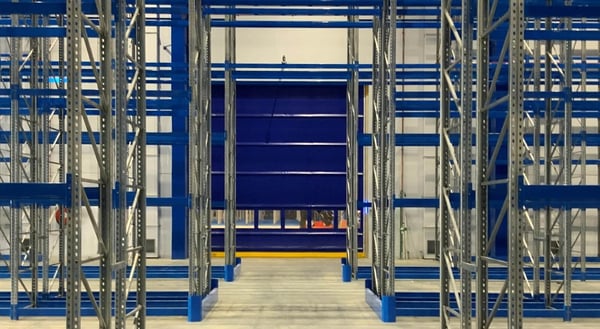
Condition 1: Condensation on equipment surfaces
Condensation in a food facility occurs when warm, humid external air meets cold internal surfaces and the moisture deposits as liquid water. In winter, when the temperature differential between outside and inside is at its greatest, even brief door openings transfer significant moisture. The consequences move through a facility in three directions.
Refrigeration coils and evaporators. When warm humid air enters a cold store repeatedly, frost accumulates on evaporator coils faster than defrost cycles can clear it. Research on cold storage energy management shows that ice build-up on evaporators reduces heat transfer efficiency, forcing compressors to work harder and consume significantly more energy. In severe cases, coil icing blocks airflow completely, causing room temperatures to rise until the refrigeration system shuts down.
Electronics, sensors, and control panels. Moisture on electrical circuits causes short circuits, sensor drift, and premature component failure. A temperature sensor that has drifted because of moisture exposure is particularly problematic as it may report conditions as acceptable when they’re not. This is among the most dangerous failure modes in a cold chain context, because the monitoring system designed to catch problems becomes the problem itself.
Overhead structures and floors. Condensation on ceiling structures drips onto food contact surfaces, product, and packaging. On floors, particularly in high-traffic door zones, it creates wet surfaces that are a direct slip hazard. According to Safe Work Australia, falls, slips, and trips account for more than 32,000 serious workers’ compensation claims annually, and are the second most common mechanism of serious workplace injury in the country.
Under Standard 3.2.3 of the Australian Food Standards Code, condensation on food contact surfaces and overhead structures is a recognised contamination risk. A facility with persistent condensation from uncontrolled door openings is, by definition, one that can fail a compliance audit.
| Condensation source | Equipment risk | Compliance risk |
| Humid air on refrigeration coils | Evaporator icing, compressor overload | Cold chain temperature excursion |
| Moisture on sensors and electronics | Sensor drift, false readings, short circuit | HACCP critical control point failure |
| Drip from overhead structures | Product contamination, wet floors | Standard 3.2.3 non-compliance |
Condition 2: Temperature fluctuations and refrigeration stress
Every time a slow door opens onto a winter environment, warm ambient air enters cold storage zones or cold air enters ambient processing zones. Both can be problematic.
For cold store and refrigerated distribution environments, the primary concern is refrigeration load. The Australian Government's energy.gov.au guidance on refrigeration specifically recommends that automatic rapid-close doors be fitted to cold rooms needing regular access, because door infiltration is one of the most direct and controllable drivers of refrigeration energy consumption. In high-traffic operations, a door that takes eight to ten seconds to close loses significantly more conditioned air per cycle than one that closes in two. Multiply that across hundreds of daily openings and you have a compressor running at elevated load, continuously, across the winter season.
The mechanical consequence is compressor wear and eventual failure. Elevated head pressure from sustained overload can increase compressor energy consumption and accelerate wear to the point where emergency repair becomes unavoidable. Emergency compressor repairs carry significant costs in parts, contractor rates, and the value of product at risk during downtime.
Temperature control at critical control points is also a foundational HACCP requirement. Under Food Standard 3.2.1, food businesses must identify, monitor, and document controls for food safety hazards, including temperature. A facility where temperature logs reflect recurring excursions driven by poor door performance is one that is difficult to audit cleanly.
Condition 3: Forklift strikes and the winter compounding effect
In food and beverage processing facilities, forklifts and pallet movers operate through the same doorways as workers, dozens or hundreds of times per day. In winter, visibility is lower, operators are wearing more layers with restricted movement, and floors near doorways are more likely to be wet. The combination increases the frequency of low-speed door strikes.
WorkSafe Victoria's guidance on forklift hazards identifies doorways and loading docks as specific forklift impact risk points, particularly in shared pedestrian-forklift zones, which describes most food processing floor environments precisely.
A standard industrial door struck by a forklift requires a service call. In a food processing environment, an out-of-service door is an uncontrolled opening. A cold storage doorway without a door has no barrier against external air, compounding every risk described in Conditions 1 and 2 for as long as it remains out of action.
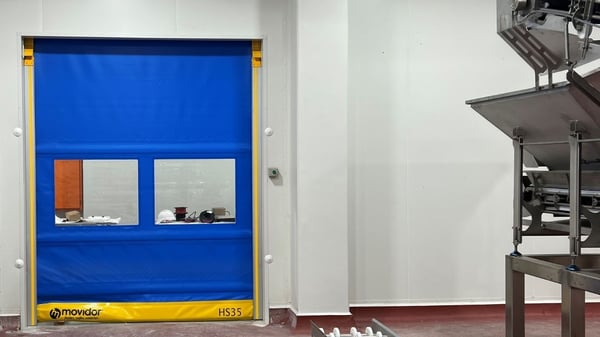
A rapid roller door with a self-relocating curtain, such as Remax's Movidor and Movichill range, reinserts automatically during the next open cycle after accidental displacement.
| Door type after a forklift strike | Outcome |
| Standard door (without self-repair) | Service call required; door out of action; uncontrolled opening persists |
| Movidor / Movichill (self-relocating curtain) | Curtain reinserts on next cycle; door operational immediately; no service call needed |
The door as first line of defence
A Movichill insulated rapid roller door, or a Movidor ES40 for ambient environments, addresses all three conditions simultaneously. High-speed operation at up to 2.0 m/sec minimises the air exchange window on every cycle. Full perimeter brush seals eliminate infiltration when closed. The self-relocating curtain removes the service call from the forklift-strike equation. Heated frame guides on the Movichill prevent ice formation at the guides in cold environments. The washable PVC curtain surface meets hygiene requirements for food processing environments.
Both products are manufactured in Australia, with same-day or next-day service from local Remax technicians. In a facility where an out-of-service door is an active food safety and compliance risk, that service model matters as much as the product specification.
To discuss which rapid roller door solution suits your facility's winter conditions, contact the Remax Doors team.
FAQ
Why does a slow door cause more equipment damage than a fast one?
The duration of each opening determines how much warm, humid air enters a cold environment, or cold air enters an ambient one. A door taking eight to ten seconds to close allows significantly more air exchange per cycle than one that closes in under two seconds. In a facility where doors cycle hundreds of times daily, that difference accumulates into substantial refrigeration overload, moisture infiltration, and energy consumption across a winter season.
What does condensation on evaporator coils do to a refrigeration system?
Frost accumulates faster than defrost cycles can clear it, reducing airflow through the coil and forcing the compressor to work harder to maintain room temperature. If ice build-up outpaces the defrost cycle, room temperatures begin to rise. Improving door performance reduces the humidity load on evaporators and the frequency of defrost cycles required.
Can a HACCP audit fail because of a door?
A door is not typically a direct HACCP critical control point, but its performance affects several that are. If poor door performance leads to documented temperature excursions, moisture on food contact surfaces, or condensation in non-compliant locations under Standard 3.2.3, those conditions will appear in audit findings. The door is the upstream cause; the audit finding is the downstream result.
How does a self-repairing door reduce downtime compared with a standard door?
A standard door struck by a forklift requires a technician visit before it is operational again, a process that can take hours or, in regional facilities, days. A Movidor or Movichill door with a self-relocating curtain reinserts on the next open cycle. The door returns to full operation without a service call or production interruption.
What temperature differential can a Movichill door handle?
The Movichill insulated rapid roller door is rated for temperature differentials of up to 30°C, covering the vast majority of cold room and frozen storage applications. Its multi-layer PE foam and PVC curtain, combined with full perimeter brush seals and heated frame guides, maintains thermal separation across high-traffic openings continuously.