




Last Updated: November 4, 2026
Quick Summary
The top five warehouse automation solutions for logistics are automated storage and retrieval systems (AS/RS), autonomous mobile robots and AGVs, robotic picking and sortation, warehouse management and execution software, and high-speed industrial doors. Each suits a different constraint, so match the technology to your throughput, building and budget rather than ranking by hype.
- AS/RS delivers the biggest space gains but suits stable, high-volume sites with long leases.
- AMRs navigate dynamically and scale with volume, but need traffic orchestration to avoid queues.
- Robotic picking and sortation pay off at high, repeatable volume and struggle with high variability.
- Ask every supplier for a five-year total cost of ownership in AUD, not a headline price.
- Sequence spend: fix the doorway and flow, then automate movement, then storage.
Table of Contents
- Five Warehouse Automation Technologies Worth Comparing
- Automated Storage and Retrieval Systems: Best for High-Bay Density
- Autonomous Mobile Robots and AGVs: Best for Flexible Goods Movement
- Robotic Picking and Sortation: Best for High-Volume Order Fulfilment
- Warehouse Management and Execution Software: The Layer That Makes Automation Pay
- High-Speed Industrial Doors for Warehouses: The Automation Most Sites Skip
- Warehouse Automation Benefits, Costs and Payback in Practice
- Choosing the Right Solution for Your Operation
- Frequently Asked Questions
Five Warehouse Automation Technologies Worth Comparing
Warehouse automation is the use of technology to move, store, pick and track goods with less manual handling. For logistics operations, the practical question is not whether to automate, but which layer to automate first. This guide compares five warehouse automation technologies on use case, cost profile and implementation reality, so you can match a solution to your throughput, your building and your budget.
How This Comparison Works
Each solution is assessed on five criteria: throughput gain, space efficiency, labour dependency, implementation complexity and payback horizon. None of these technologies is universally best. An automated storage and retrieval system that suits a high-bay distribution centre would be wasted capital in a small cross-dock. We rank by fit, not by hype.
Automated Storage and Retrieval Systems: Best for High-Bay Density
An automated storage and retrieval system (AS/RS) is a racking structure served by robots or cranes that move goods between storage locations and picking stations without a person travelling to the rack. AS/RS delivers the biggest space gains of any option here, because it builds upward and removes aisle width. Goods-to-person handling also cuts walking time, which is often the largest single component of picking labour.
Which Logistics Operations Actually Suit AS/RS
AS/RS is not one product. The two main configurations behave very differently on site, and the choice between them should follow your order profile rather than your building height.
- Unit-load AS/RS stores and retrieves whole pallets or large totes. It suits high-volume distribution centres and third-party logistics (3PL) operations moving full-pallet replenishment to pick faces, where throughput is measured in pallets per hour and SKU velocity is relatively stable. Because the crane handles one unit at a time, the economics depend on keeping the racking full and the pick faces replenished in bulk.
- Mini-load and shuttle AS/RS handles cases, totes and individual items. It suits e-commerce fulfilment and spare-parts operations where the SKU count is high, the order profile is fragmented, and the goal is to bring the right tote to a picker without the picker walking the aisle. Shuttle systems trade the single-crane bottleneck for multiple robots running on the same rack level, which lifts throughput but adds orchestration complexity.
Cold storage is a special case worth calling out. An AS/RS in a freezer or chill store removes people from a hostile environment, which is a safety and labour-retention argument as much as a throughput one.
Comparable Metrics to Demand from an AS/RS Supplier
Because AS/RS is capital-intensive and engineered to your building, the business case lives or dies on numbers the supplier should be able to defend. Ask for these in writing, and compare them across every proposal:
- Throughput in storage and retrieval transactions per hour, at your peak profile, not at a nominal average.
- Storage density in pallet or tote positions per square metre of floor, including the aisle and service space the system consumes.
- Order accuracy and the mechanism that produces it, for example, scan-verified putaway and pick-to-light at the goods-to-person station.
- Uptime and mean time to repair, with the spares and service model that supports it.
- Payback horizon in months, built from your labour cost per hour, your current cost per order, and the throughput the system must sustain.
A common pattern is for proposals to quote peak throughput that assumes perfect inbound labelling and a full racking profile. Test the assumption. If your receiving process is inconsistent, the AS/RS will simply store the errors more efficiently.
Implementation Reality and When Not to Automate
AS/RS is a construction project as much as an equipment purchase. Expect building works, fire and safety sign-off, integration with your warehouse management system (WMS) or warehouse execution system (WES), and a phased cutover that keeps the site running.
Watch out: AS/RS is the wrong first move for a site with a short lease, a SKU range in constant churn, or a throughput profile that swings sharply between peak and off-peak.
Autonomous Mobile Robots and AGVs: Best for Flexible Goods Movement
Autonomous mobile robots (AMRs) and automated guided vehicles (AGVs) both move goods around a facility, but they suit different operations. AMRs navigate dynamically using onboard sensors and mapping, so they work around people and obstacles without fixed paths. AGVs follow defined routes using wires, tapes or markers, which makes them predictable and well suited to repetitive, high-volume transfers. Flexible automation is the main appeal: you can add robots as volume grows rather than rebuilding the site.
AMR vs AGV: What Actually Differs on Site
What separates an AMR from an AGV is route flexibility. An AMR maps its environment and recalculates paths in real time, so layout changes need software updates, not civil works. An AGV follows a fixed path, which means predictable cycle times but expensive changes when your layout shifts. In practice, AGVs suit pallet handling on stable routes; AMRs suit case handling and order picking where the floor plan evolves.
Robotic Picking and Sortation: Best for High-Volume Order Fulfilment
Robotic picking arms and automated sortation systems pay off where order volume is high and repeatable. Sortation systems divide a mixed stream of parcels or cases into destination-specific lanes, which lifts order accuracy and reduces mis-ships. Robotic picking handles repetitive picks at a steady rate that does not tire or slow. Both are throughput machines: they are weakest in low-volume, high-variability settings where changeover dominates.
Warehouse Management and Execution Software: The Layer That Makes Automation Pay
A warehouse management system (WMS) is software that controls inventory, order fulfilment, putaway and replenishment across the facility. A warehouse execution system (WES) sits closer to the equipment, coordinating robots, conveyors and sorters in real time. Software is the layer most sites underinvest in, and it is the layer that decides whether hardware delivers. Real-time visibility, predictive analytics and optimisation only work when the software knows where every item is.
| Solution | Best For | Main Strength | Main Limitation |
|---|---|---|---|
| AS/RS | High-bay, stable SKU profiles | Space utilisation, goods-to-person | Fixed infrastructure, long lead time |
| AMRs | Evolving layouts, case handling | Flexible, scalable deployment | Needs traffic orchestration |
| AGVs | Repetitive pallet routes | Predictable cycle times | Rigid paths, costly layout changes |
| Robotic picking and sortation | High-volume fulfilment | Throughput and order accuracy | Weak with high variability |
| WMS/WES | Every automated site | Coordination and visibility | Cannot fix poor processes |
High-Speed Industrial Doors for Warehouses: The Automation Most Sites Skip
Here is the part most automation plans miss: the doorway. Pair the door with the right sensors and accessories and it responds to approaching traffic automatically.
Click here to view Australian Made High Speed Industrial Doors. →
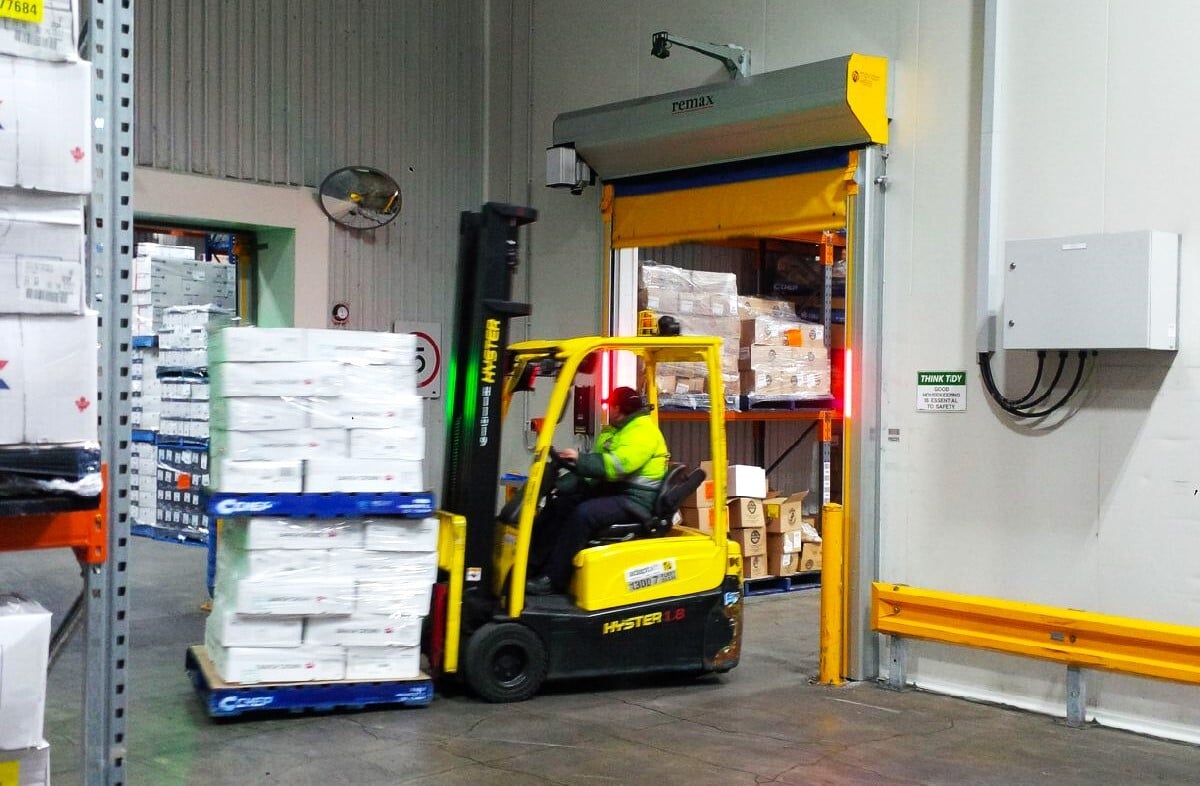
For food production and cold storage, door choice also governs hygiene and energy loss. You can view the Movidor rapid roller door to see how the rapid cycle and tight seal address this.
Warehouse Automation Benefits, Costs and Payback in Practice
Warehouse automation benefits fall into four buckets: labour productivity, space utilisation, order accuracy and operational uptime. The costs fall into more buckets than most business cases admit. Beyond equipment, budget for system integration, staff training, downtime during installation and ongoing maintenance. Total cost of ownership is where proposals diverge, so ask every supplier for a five-year view that includes service and spares, not just the purchase price.
A Five-Year Total Cost of Ownership Model You Can Apply to Any Option
Most automation business cases fail not because the equipment is wrong but because the cost model stops at the purchase order. A defensible five-year view has five lines, and every supplier should be asked to populate all of them:
- Capital cost, equipment, racking or civil works, and the controls and software licences that make it run.
- Integration cost, connecting the new system to your existing WMS or WES, including middleware, interface development and testing. This line is routinely underestimated and is often the difference between a project that lands on time and one that slips.
- Installation and downtime cost, the labour and lost throughput while the site is reconfigured. For a live 3PL or e-commerce fulfilment centre, this can exceed the integration line.
- Operating cost, energy, maintenance contracts, spares, consumables and the staff who supervise the system rather than perform the manual task.
- End-of-life and change cost, the cost of reconfiguring or removing the system when your layout, lease or product profile changes. Fixed infrastructure carries a higher number here than flexible automation.
Ask for the five-year total in AUD, not a headline purchase price, and ask which line the supplier is excluding. The exclusions are where the payback case usually breaks.
How Payback Actually Works, Technology by Technology
Payback depends on what you are replacing, and each of the five solutions earns its return through a different mechanism:
- AS/RS pays back through space and labour travel. The return is strongest where land or rent is expensive, the building is tall, and picking labour is a large share of cost per order. It needs volume and a stable SKU profile to justify the fixed spend.
- AMRs and AGVs pay back through flexible labour substitution and the ability to scale with volume rather than rebuild the site. The return is weaker if the real problem is congestion rather than travel, because a fleet of robots in a congested flow becomes a queue.
- Robotic picking and sortation pay back through throughput and order accuracy at high, repeatable volume. The return collapses in low-volume, high-variability settings where changeover dominates.
- WMS and WES pay back through visibility and coordination, the layer that lets every other investment deliver. A WMS cannot fix a broken process, but without it the hardware cannot be orchestrated.
- High-speed industrial doors pay back through dock cycle time and energy loss. A door that opens and closes in seconds rather than minutes cuts the time a forklift waits at a dock and protects cold chain integrity, which shows up on the energy bill and in product loss rather than in a throughput chart.
A common pattern is that door and flow upgrades deliver faster payback than any robot on the floor, because the capital outlay is smaller and the running-cost saving starts immediately. That is why sequencing matters.
Sequencing the Spend
Distribution centre managers weighing this can review distribution centre solutions for sector-specific context before committing capital. Our advice: sequence your spend. Fix the doorway and the flow, then automate the movement, then automate the storage. Each layer should be measured against the same three numbers, peak throughput, cost per order and available floor area, before the next layer is approved.
Choosing the Right Solution for Your Operation
Start with your constraint, not the technology. If space is your bottleneck, look at AS/RS. If labour travel is the problem, look at goods-to-person and AMRs.
Use this checklist before signing anything:
- Measure current throughput and cost per order at peak
- Identify the single biggest constraint in the flow
- Confirm the building can support the chosen infrastructure
- Request a five-year total cost of ownership, including maintenance
- Check integration requirements with your existing WMS
- Confirm local spares and service response times
- Plan change management and staff training before go-live
A common mistake is automating everything at once. Phased implementation keeps the site running and lets you measure each layer. If you are ready to talk through your operation, contact our team to discuss your site.
Frequently Asked Questions
What are the main types of warehouse automation?
Most logistics sites choose from five broad categories: automated storage and retrieval systems (AS/RS) for dense high-bay storage, autonomous mobile robots (AMRs) and automated guided vehicles (AGVs) for goods movement, robotic picking and sortation for order fulfilment, warehouse management and execution software (WMS/WES) to coordinate everything, and high-speed industrial doors that control the flow of goods, people and air at every transition point. Most successful sites combine two or three rather than betting on one.
Which warehouse automation solutions are best for logistics operations?
It depends on where your throughput is actually lost. If picking is the bottleneck, robotic picking and sortation deliver the clearest gains. If space is tight, AS/RS recovers floor area through high-bay storage. If labour is spent walking and pushing carts, AMRs move goods to people instead. If truck turnaround and climate control are the constraint, high-speed industrial doors for warehouses often deliver the fastest payback of any option because they cut cycle time at the dock without touching your racking.
How do you choose the right warehouse automation system?
Start with measured data, not vendor brochures. Record current throughput per hour, order accuracy, space utilisation, labour hours per order and dock turnaround time. Then identify the single constraint that limits the whole operation. Match the technology to that constraint first, confirm the software can integrate with your existing WMS, and model total cost of ownership including installation, integration, maintenance and downtime. A solution that fixes a secondary problem rarely pays back.
How can automated doors improve warehouse logistics?
Doors are the most frequently cycled equipment on a loading dock, so they set the pace of goods movement and the rate at which conditioned air escapes. Rapid-cycle doors shorten truck turnaround, and self-repairing systems such as the Movidor crash relocation design restore operation quickly after an impact instead of leaving a bay out of service. On cold storage and food sites, tighter seals also reduce energy loss and support hygiene and pest control requirements.
Automating a warehouse is a sequence of decisions, not a single purchase, and the doorway is where most sequences start. Remax Doors manufactures Australian-made industrial door systems, including the Movidor high-speed rapid roller door with its self-repairing crash relocation system, backed by nationwide installation and preventative maintenance support. Get started with Remax Doors and build a facility that keeps goods moving without the bottlenecks.